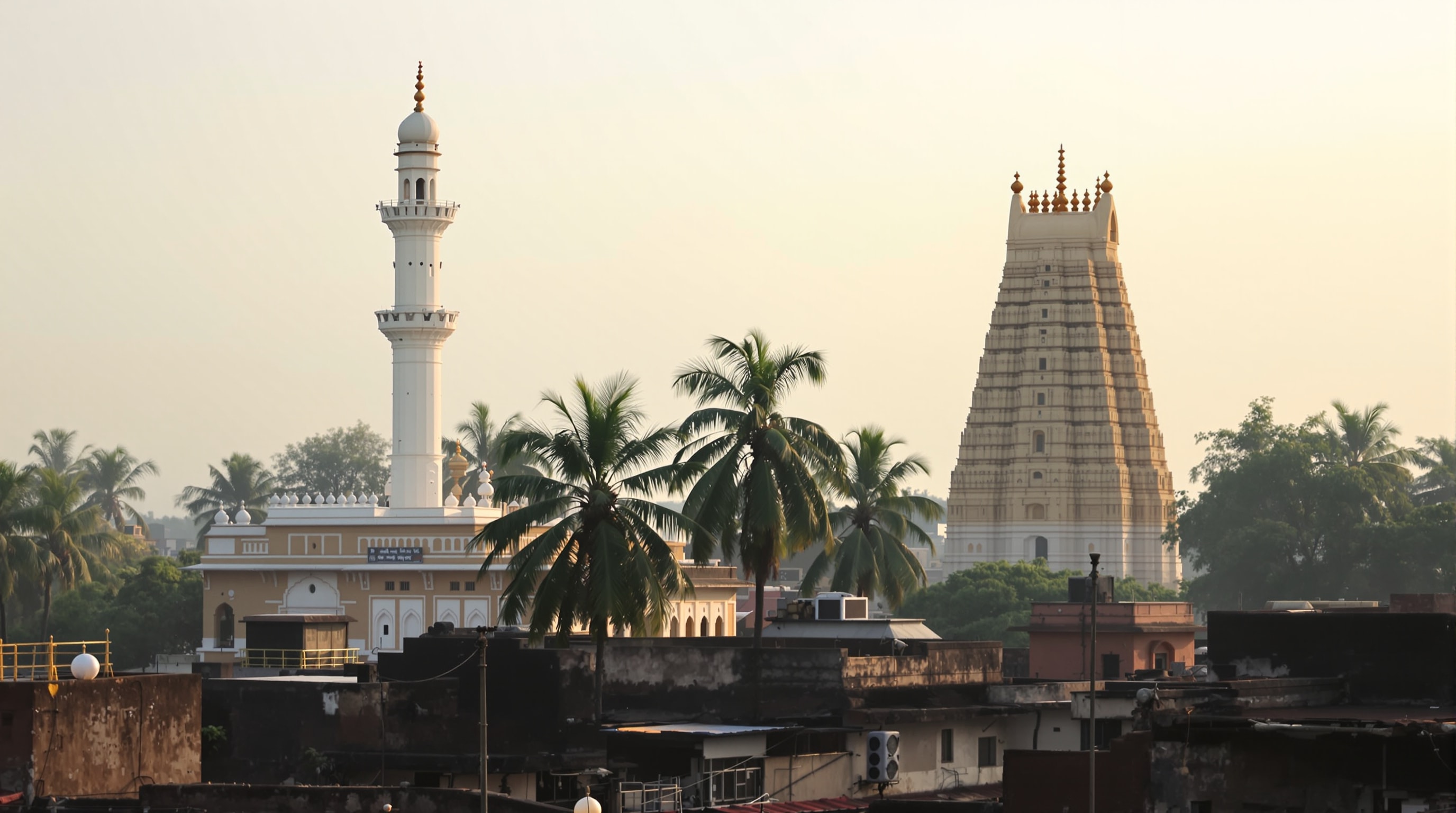
What makes Eruvadi memorable is less any single monument than the texture of its community life: a small town where three faiths share the same compact grid of streets, where voluntary associations do much of the work of civic life, and where the calendar is crowded with the festivals of everyone who lives there. This page describes that fabric as it has long been - as general information, not on behalf of any group.
A Plural Town
Eruvadi is predominantly Muslim - roughly 58 per cent of residents at the 2011 Census - with Hindus making up a little over a third and Christians a smaller but well-established share. These are not separate settlements but neighbours within one town, and Eruvadi is often cited in the region as an example of long-standing, everyday coexistence. The practical result is a place where a mosque's call to prayer, a temple bell and a church service can all be heard within the same few streets, and where residents routinely take part in one another's celebrations.
Mosques, Temples and Heritage Buildings
The town's religious architecture is also its heritage architecture. Among its notable buildings are the historic Muhaam Jumma Masjid, which carries old inscriptions, and the Baith-As-Salaam mosque with its minaret; the older Hindu temple on the southern bank predates much of the modern town. For visitors these are best appreciated respectfully, as living places of worship and as markers of the town's layered past rather than as ticketed sights. Their orientation and placement - the mosques built facing the Kibla, the temple anchoring the original riverside village - tell the same story of planned, deliberate growth described in the history section.
The Culture of Associations
One of the most striking features of Eruvadi's civic life is how much of it is organised through voluntary associations, both in the town and among its diaspora. Over the years residents have founded bodies devoted to education, community welfare, care for the elderly and local development, and the Gulf diaspora has formed hometown associations in cities such as Dubai and Riyadh to support projects back home. Named institutions of this kind are part of the town's civic fabric and are described here only in general terms; this site is independent and speaks for none of them.
Festivals and the Shared Calendar
Because Eruvadi is home to several communities, its year is unusually full. The Islamic calendar brings Ramadan and the two Eids; the Hindu calendar brings Pongal - the great Tamil harvest festival - along with temple festivals and Deepavali; and the Christian calendar brings Christmas and Easter. Pongal in particular is a whole-region occasion in the Tamil south, tied directly to the paddy harvest that has always sustained the town. The overlapping festivals are part of what gives daily life here its rhythm.
Language and Learning
The language of the town is Tamil, one of the world's oldest living literary languages, and Eruvadi shares the strong emphasis on education that characterises much of Tirunelveli district. That emphasis has been reinforced by the diaspora, whose remittances have helped fund schools and support students. The region's tradition of producing notable educationists and philanthropists is a real one; among the best known with roots in the broader Tirunelveli Muslim community is the entrepreneur and educationist B. S. Abdur Rahman, whose charitable and educational institutions became widely known across Tamil Nadu.
Experiencing the Town Respectfully
For anyone visiting, the best of Eruvadi's culture is encountered simply by walking its streets, buying from its shops and treating its places of worship as the community spaces they are. There is no visitor centre and no admission gate - which is precisely the point. To understand how this compact community connects to the wider world, continue to the Gulf connection page.