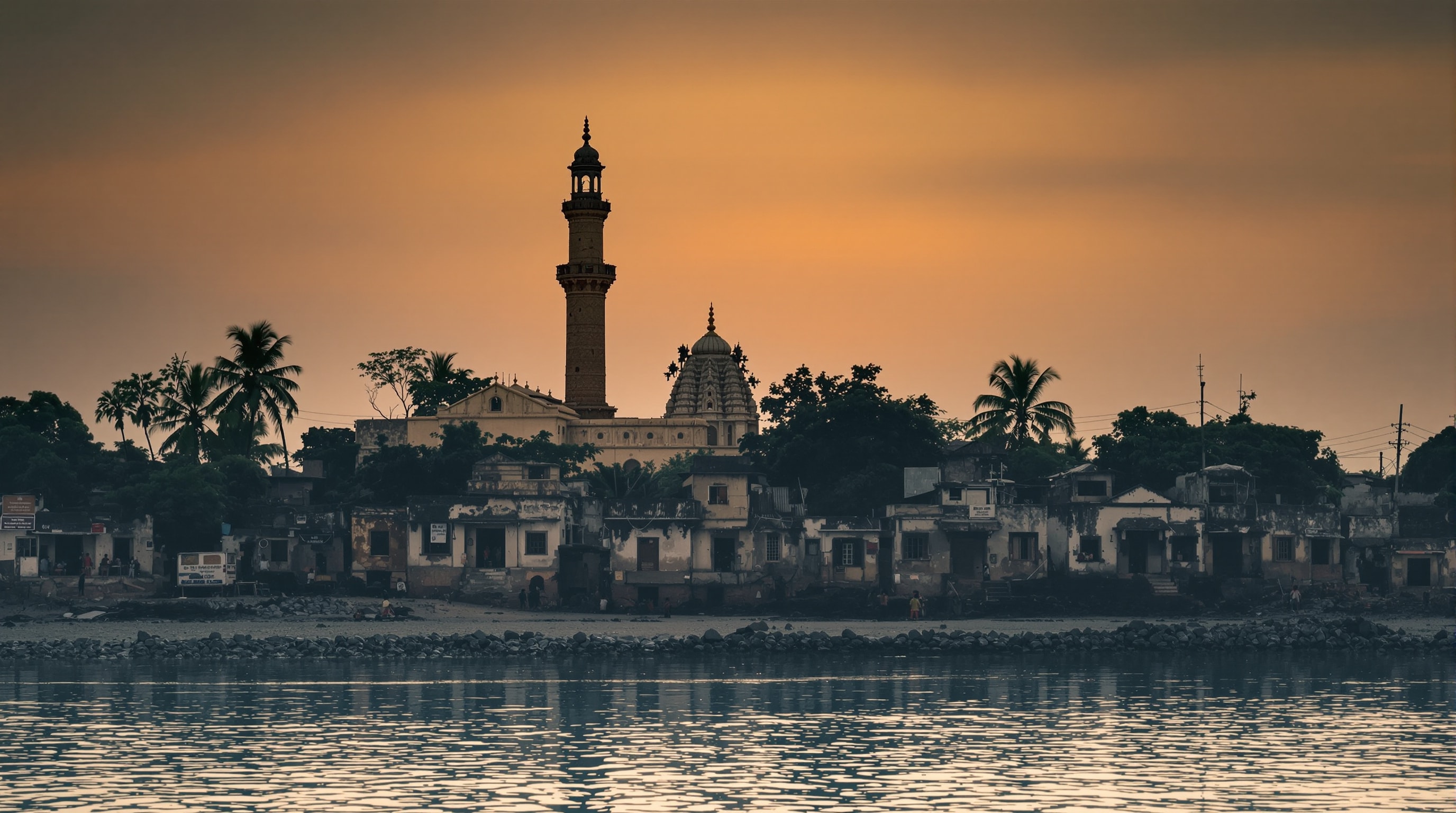
For a small town, Eruvadi carries a surprisingly rich local history, one that can be traced back several centuries and that is preserved in an unusually charming story about its own name. Like much of the far south, its past is a layering of farming settlement, the spread of new communities, and the small linguistic accidents of the colonial era.
The Story Behind the Name
By local tradition, the original name of the place was Air Paadi. During the ploughing season, farmers working the paddy fields would sing as they worked - and it was this singing at the plough that is said to have given the settlement its first name. Over time "Air Paadi" softened, for ease of speaking, into "Air Vaadi." During British rule the district officers struggled to pronounce Airvaadi and rendered it "Eruvadi" instead - the very same process that turned Thoothukudi into "Tuticorin" and Thirunelveli into "Tinnevelly" on colonial maps. The anglicised form stuck, and Eruvadi it has remained.
An Old Settlement on the Nambi
The history of the town can be traced back roughly 800 to 1,000 years. The original village stood on the southern bank of the Nambi river, next to the temple and the paddy fields that surrounded it. On the northern side of the river lay a small bushed wilderness known as Puliyur - the area of today's numbered streets - and the neighbouring hamlet of Puliyur Kurichi still carries the older name. The river, then as now, was the organising line of the whole settlement.
Growth Across the River
As new communities settled and the population grew, the people of Eruvadi needed more room to build homes and places of worship, and the town expanded northward across the river into Puliyur. What is striking is how deliberately this expansion was carried out. Rather than let the new quarter sprawl, the settlers planned it so that every street would run down to and end at the river bank, keeping the water at the centre of daily life. This planned grid - streets meeting the river - is the physical legacy of that period and remains one of the town's defining features.
Faith and Civic Life
The spread of Islam in the region is an important thread in the town's story; local tradition associates the early Muslim presence in this part of Tirunelveli with a Sufi figure remembered as Saiyid Ibrahim, some centuries ago. As the community established itself, mosques were built oriented toward the Kibla, and a Panchayat Chavadi - a common hall where residents gathered to discuss matters and settle disputes - was created as a centre of civic life. Alongside this, the town's older temples and, later, churches gave Eruvadi the plural character it still has today, described further on the community and culture page.
Into the Modern Era
In the twentieth and twenty-first centuries the town's history has been shaped as much by departure as by settlement, as thousands of its people left to work in the Gulf and returned - or sent home - the means to rebuild and expand the town. That more recent chapter is told in the Gulf connection section. Taken together, the long arc runs from singing ploughmen on the southern bank to a globally connected community that still gathers, as it always has, along the Nambi.
Sources and Further Reading
The naming tradition and the account of Puliyur are drawn from long-standing local history preserved in community records; the broader regional context, including the traditions surrounding the spread of Islam in the town, is summarised in the encyclopaedic entry for Eruvadi. For the district's deeper past, see the entry for Tirunelveli district.